
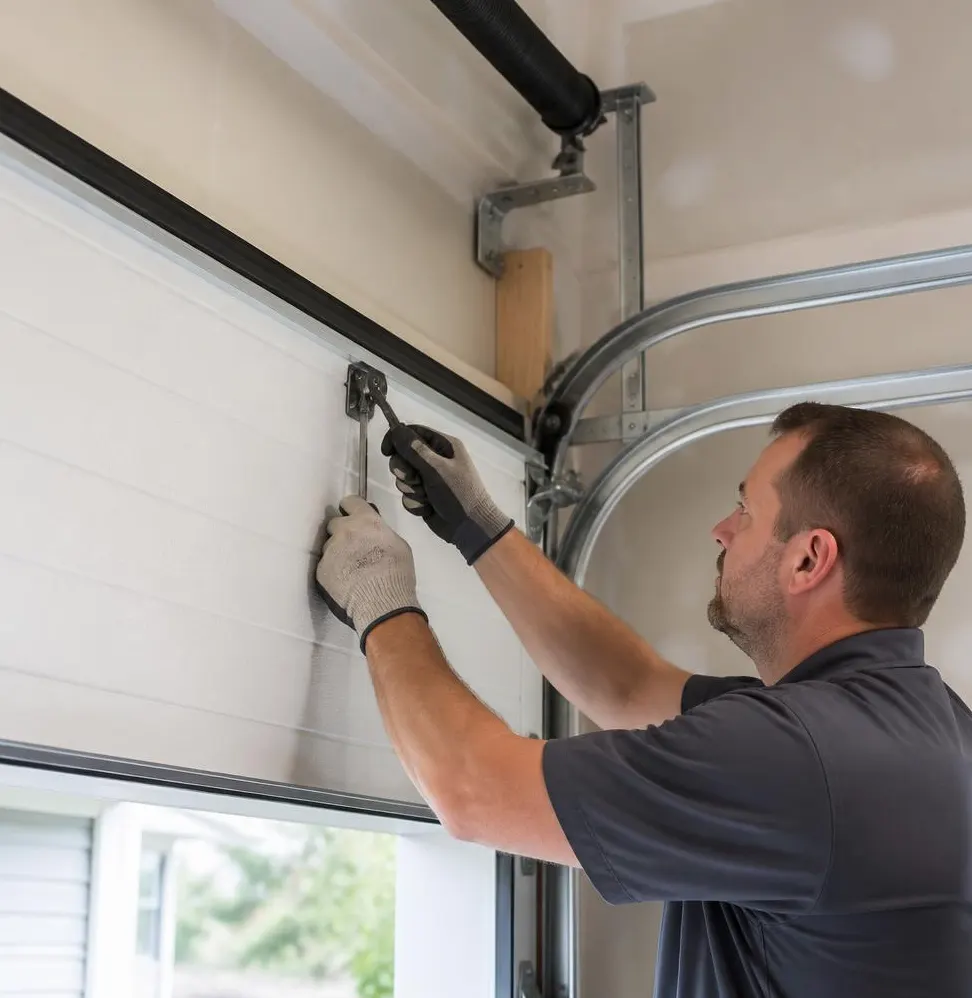
The Rule, and the Narrow Exception
If the job involves a torsion spring, don't do it yourself — treat it like live electrical work, because the stored energy behaves the same way when it's released wrong. The one narrow exception is a straightforward extension spring swap on a lightweight single garage door, done with the door physically propped open and the correct tools on hand. Even then, a lot of homeowners who attempt it still get hurt, because the warning signs of trouble (a spring that's wound tighter than expected, a cable that's frayed, a pulley that's seized) aren't obvious until the moment something lets go.
What Actually Goes Wrong
A torsion spring sits above the door and holds enough twisted tension to lift 200 to 400 pounds of door, wound through roughly seven to ten full turns. That energy doesn't care whether you're ready for it. The injuries that send people to urgent care or the ER almost always trace back to one of these:
- The winding bar slips out of the cone. If someone uses a screwdriver or an undersized bar instead of a properly fitted winding rod, the spring can unwind in a fraction of a second, whipping the bar around with enough force to break fingers, fracture facial bones, or knock someone off a ladder.
- The spring is removed while still under tension. Unwinding has to happen first, fully, before any bolts come out. Skip that step and the spring can detach violently, launching metal fragments or snapping cables.
- The door isn't secured and it falls. Without the spring holding tension, an unsupported garage door can drop fast — enough to crush a hand, fracture a foot, or injure anyone standing underneath.
- Mismatched or wrong-length springs are installed. This doesn't cause an injury on day one, but it puts uneven, unpredictable strain on the system, which is exactly how a door shifts or a cable snaps weeks later with no warning.
These aren't rare freak accidents — they're the predictable result of a high-tension mechanical system meeting the wrong tool or the wrong technique, and it happens to confident, capable homeowners just as often as first-timers.
Why the Desert Adds Risk
Extreme heat and intense UV exposure put extra fatigue cycles on springs and coatings over time, and a spring that's already stressed from months of 110-plus-degree afternoons doesn't always behave the way a textbook diagram says it should. A coil that looks intact can have uneven tension or a weak point that only reveals itself once someone starts winding or unwinding it. That unpredictability is one more reason this isn't the repair to learn on the fly in your driveway.
The Specific Actions That Prevent a Trip to the ER
- Disconnect the garage door opener before doing anything, so the motor can't engage mid-repair.
- Clamp or secure the door in the open position with locking pliers on the track — never rely on the spring alone to hold it.
- Use properly sized winding bars (typically ½-inch steel rods matched to the cone), not screwdrivers, wrenches, or anything improvised.
- Stand to the side of the spring while winding or unwinding, never directly in front of it.
- Count turns carefully and match them to the spring's rated specifications — too few turns under-lifts the door, too many over-stresses the coil.
- Replace torsion springs in pairs, even if only one has failed; the surviving spring is usually close behind it on the wear curve.
- Never work alone on this specific repair — have a second person present in case something goes wrong.
If any of this sounds like more equipment and precision than you've got on hand, that's the point. A $20 winding bar doesn't change the physics of a 200-pound door held up by twisted steel.
When to Call Mesa Garage Door Pro
If your door won't open, the spring looks stretched or gapped, or you hear a loud bang (the classic sound of a torsion spring snapping), it's time to call rather than reach for a ladder. Our Garage Door Spring Replacement service includes identifying the correct spring type and size, replacing both springs on a torsion pair, and running a full balance test before we leave — not just swapping the obvious broken part. We also offer Garage Door Maintenance & Tune-Up visits that catch spring wear, cable fraying, and pulley damage before any of it turns into a same-day emergency.
If your garage door spring has failed or looks close to it, call Mesa Garage Door Pro. We serve Mesa, Gilbert, Tempe, Chandler, Scottsdale, Apache Junction, Queen Creek, and Gold Canyon, and we can usually get a technician out the same day.